Citrus greening was discovered in 2005. Since then, it has caused widespread damage to the Florida citrus industry, and there is still no known cure. The Citrus Research and Development Foundation (CRDF) was established in 2008 to address HLB. Since then, many products, procedures, and systems have been tried. No single approach has become the established, industry-wide solution, and Florida’s citrus industry continues to face an uncertain future.
Early trial observations — Hamlin and Valencia
In third-party field trials summarized on this site, CitruSaver has shown promising responses within about 4.5 to 6 months on linked Hamlin and Valencia studies. Results vary by grove, season, and management.
Why CitruSaver exists
CitruSaver Fertilizer was designed, studied, and developed in response to the pressure Huanglongbing (HLB) has placed on Florida citrus. Our formula has been evaluated in third-party field trials, and we continue to invest in research and product improvement to give growers a practical, irrigation-based option outside of antibiotic trunk programs.
Antibiotic use in citrus — questions raised in public debate
Citrus greening has drawn national attention, and the use of antibiotics in groves has been covered critically, including by National Geographic. Groups such as “Keep Antibiotics Working” have asked regulators to revisit Section 18 emergency registrations for agricultural oxytetracycline, citing concerns about implications for human antibiotic effectiveness. Separately, public health discussions have tied broad antibiotic overuse to the spread of highly resistant bacteria.
Research messaging on resistance (general)
The National Institutes of Health and other health authorities have warned about rapid emergence of resistant bacteria globally and the risk that poses to the usefulness of antibiotics when they are misused or overused.
CRDF 2017 bactericide trial — scale and mixed outcomes
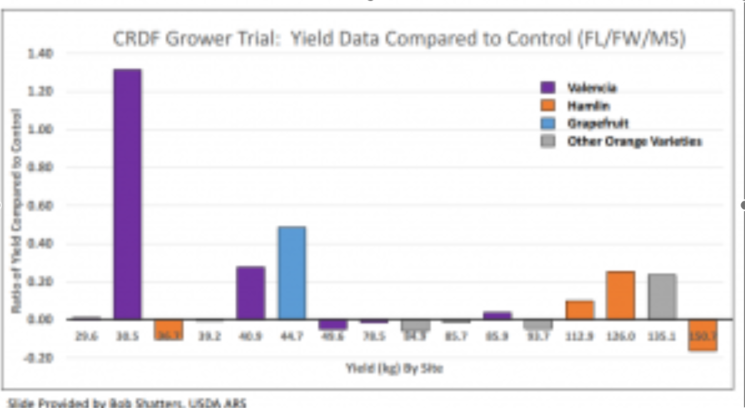
The August 2017 CRDF trial treated more than 131,000 acres with products including MycoShield, FireLine, and FireWall. Public materials from that period stated that multiple years of treatment might be needed before hoped-for results. In the “CRDF Bactericide Field Trial Update” presented at the Citrus Expo on August 17, 2017, eight of sixteen trial sites reported lower fruit yield than untreated trees.
: